
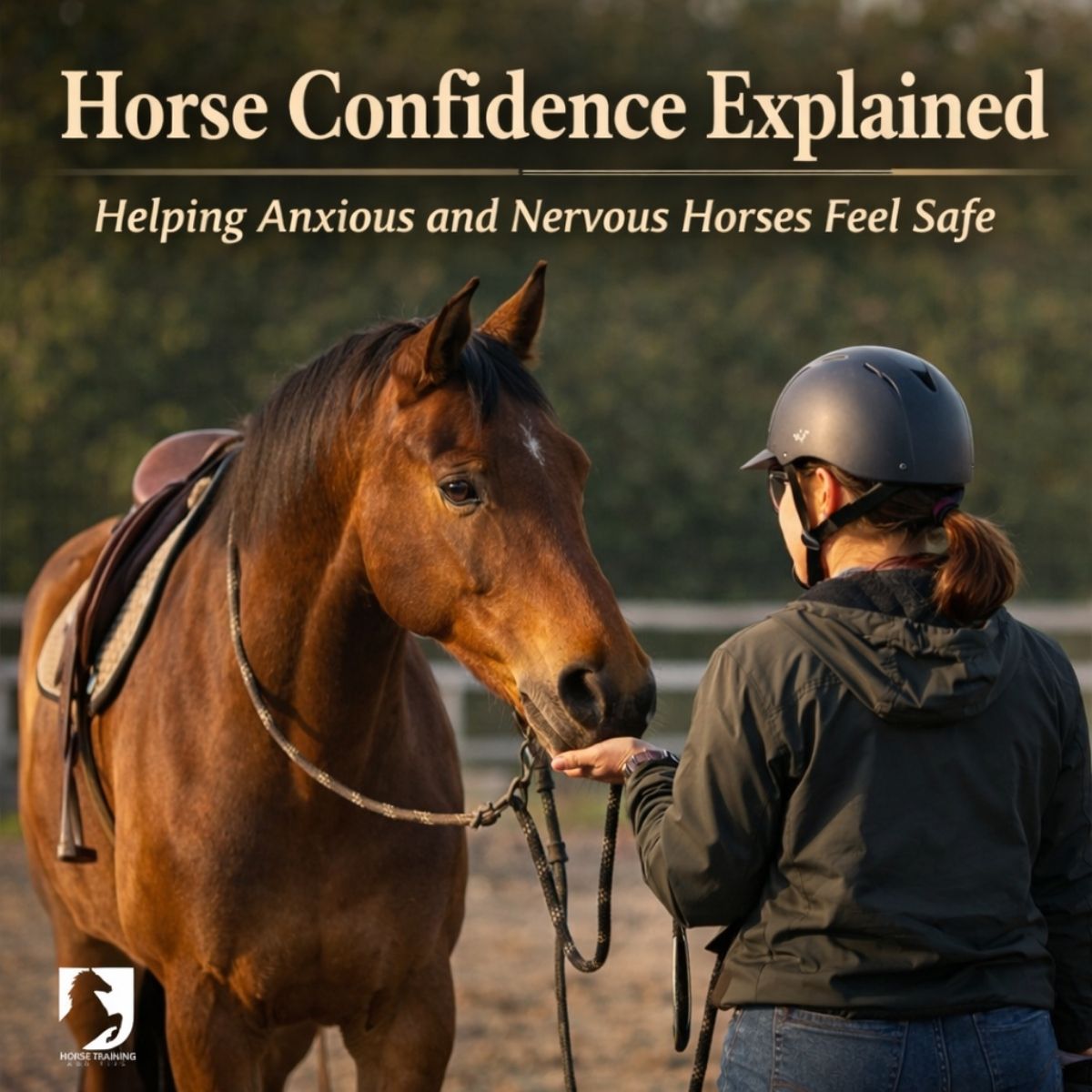
Horse confidence gets talked about as if it’s a personality trait.
Some horses are “brave”. Others are “sharp”, “nervy”, or “just spooky”.
In real life, confidence is not fixed. It’s shaped, slowly, by experience, handling, environment, and the way pressure is applied and released.
This pillar is about building genuine confidence without forcing things or slipping into dangerous shortcuts.
If your horse is tense, reactive, or uncertain, the aim isn’t to “make them behave”. It’s to help them feel safe enough to learn.
In This Pillar Series
These four supporting articles go deeper on the most common confidence problems. You can read them alongside this pillar:
- Signs of Anxiety in Horses (What Owners Often Miss)
- Why Some Horses Spook Easily (And Why Punishment Makes It Worse)
- Building Confidence in Nervous Horses on the Ground
- Helping Nervous Horses Under Saddle (Without Overfacing Them)
Note: If your final slugs are different, swap the URLs but keep the anchors unique (don’t reuse the exact same anchor text across pages).
A Calm Starting Point
If you’re dealing with an anxious horse, it can feel like you’re walking a tightrope.
Push too much and they blow up. Do too little and nothing improves.
Most people end up stuck in the middle: managing the behaviour day-to-day, but not quite building the confidence underneath it.
Confidence work is often quieter than people expect.
It’s not dramatic “desensitising sessions” or winning a tug-of-war.
It’s a long run of small, correct experiences where the horse learns: “I can cope, and my person will keep things fair.”
That’s what this pillar is for: a practical way to think about confidence so you can make better choices week by week.
What Confidence Actually Means in a Horse
Confidence isn’t bravado. It isn’t “boldness”.
In horses, confidence is closer to predictability and capacity.
Confidence is predictability
A confident horse can predict what will happen next.
They understand the job, the rules are consistent, and the environment feels readable.
That doesn’t mean they never worry. It means worry doesn’t take over.
Confidence is capacity
A confident horse has enough emotional “spare space” to think.
When something changes, they can notice it, assess it, and still respond to you.
An anxious horse loses that thinking space quickly. They flip into reaction.
Confidence is learned, not demanded
This is the bit people miss.
You can demand obedience from an anxious horse, but you can’t demand confidence.
Confidence comes from repetition of fair experiences, at a level the horse can cope with.
That’s why “just make them go past it” works for some horses and completely backfires for others.
If you’ve ever felt your horse get worse the more you “insist”, you’ve already seen this in action.
Anxiety, Fear, Stress, and Confusion: The Useful Differences
People use these words interchangeably, but they aren’t the same.
When you can tell the difference, you stop treating every problem like naughtiness.
Fear
Fear is a response to a perceived threat.
It can be obvious (a pheasant exploding from a hedge) or subtle (a corner of the arena that feels “wrong”).
Fear tends to be sharp and situational.
Stress
Stress is the body and brain working harder to cope.
Some stress is normal. The issue is when it stays high for too long.
A chronically stressed horse can look “fine” until they suddenly aren’t.
Confusion
Confusion is not knowing what the right answer is.
Horses often show confusion as hesitation, tension, rushing, or switching off.
If cues are inconsistent, or the horse is being corrected for guessing, confusion grows fast.
Anxiety
Anxiety is anticipation of threat or discomfort.
It’s the horse expecting something unpleasant, even if nothing is happening yet.
This is why some horses start worrying at the gate, at the mounting block, or the moment you pick up the reins.
If you want a clear checklist of what anxiety looks like before it becomes dramatic, use the supporting article: Signs of Anxiety in Horses (What Owners Often Miss).
How Anxiety Shows Up in Real Life
Anxiety isn’t always rearing, bolting, or spinning.
Often it’s quieter and easier to misread.
The “busy” horse
These horses can’t quite stand still.
They fidget, paw, swing their quarters, mouth the bit, barge, or nip the lead rope.
They’re often labelled rude, but many are simply overfull with nervous energy.
The “stuck” horse
Some horses freeze instead of explode.
They plant, lock their neck, or refuse to go forward.
If you only ever respond by escalating pressure, you teach them that the situation truly is unsafe.
The “looky” horse
These horses scan everything.
Head up, muscles tight, breath shallow, attention pinging from one thing to the next.
If you punish that lookiness, spooking usually escalates.
If this is your horse, the spooking-focused supporting article will help: Why Some Horses Spook Easily (And Why Punishment Makes It Worse).
The “switched off” horse
Not every quiet horse is calm.
Some are shut down: they comply, but with a flat expression, minimal curiosity, and little resilience.
This can be a response to overwhelm, harsh handling, pain, or repeated conflict.
The “fine until it isn’t” horse
Some horses cope until the load tips over.
They appear manageable for weeks, then have a sudden blow-up that seems to come out of nowhere.
Most of the time, the signs were there earlier, just subtle.
Why Confidence Problems Develop
Very few horses are born “problem horses”.
Most confidence issues develop because the horse is repeatedly put in a situation they can’t process comfortably.
Sometimes that’s obvious: a frightening event, a bad fall, a painful tack issue.
Sometimes it’s a drip-feed: inconsistent cues, rushed training, too much pressure too soon, or a lifestyle that keeps their body on edge.
In the next chunk we’ll get specific about causes, including how pain, environment, learning history, and rider/handler habits interact.
What You’re Aiming For
Confidence isn’t the absence of fear.
It’s the presence of enough safety and clarity that the horse can return to thinking.
The goal is a horse who can:
- Notice something new without instantly reacting
- Look to you for guidance instead of running through you
- Recover quickly after a wobble
- Learn calmly because the steps make sense
That kind of horse is built through consistent, fair work.
Not through battles, and not through endless avoidance.
Horse Confidence Explained: Helping Anxious and Uncertain Horses Feel Safe
Why Horses Lose Confidence in the First Place
When a horse struggles with confidence, the behaviour you see is rarely where the problem began.
Anxiety, spooking, tension, or resistance are usually the end result of something that has been building quietly over time.
This matters, because surface-level fixes rarely last.
Real improvement comes from understanding what is driving the horse’s response underneath.
Confidence Is Context-Specific
One of the most confusing things for owners is that confidence does not carry evenly across situations.
A horse can hack calmly but feel anxious in the school. They may be settled on the ground but tense once ridden.
This does not mean the horse is being awkward.
It means confidence is learned in layers.
If a horse has not learned how to cope in a specific context, anxiety fills the gap.
Handling and Training History
Inconsistent pressure and release
Horses learn through pressure and release, whether we intend to teach them or not.
If pressure is unclear, delayed, or never fully released, horses become tense and unsure of their responses.
Common examples include:
- Asking for forward movement while blocking it with the hand
- Correcting the horse after they have already tried to respond
- Changing expectations from one session to the next
Over time, the horse stops being confident in their answers because the rules feel unreliable.
Being corrected for confusion
Many anxious horses are not being disobedient. They are guessing.
If a horse is corrected every time they guess incorrectly, they learn that trying carries risk.
That is when hesitation, tension, and shutdown behaviour begin to appear.
Rushed foundations
Horses that are rushed through early handling or training often appear fine until the work becomes more demanding.
Without clear basics, confidence has nothing solid to rest on.
This is where slow, methodical groundwork becomes essential:
Building Confidence in Nervous Horses on the Ground
The Role of Environment
Unpredictable surroundings
Some horses cope well with change. Others rely heavily on routine.
Frequent changes in turnout, companions, feeding times, or workload can quietly undermine confidence.
Overstimulating yards
Busy yards are not neutral environments.
Constant movement, noise, and social pressure can keep sensitive horses permanently on edge.
These horses may appear manageable until they are asked to concentrate or learn something new.
Lack of genuine downtime
A horse that never fully switches off cannot build emotional resilience.
Confidence grows when the nervous system is allowed to return to baseline regularly.
Pain and Physical Discomfort
This cannot be overstated.
Unresolved discomfort is one of the most common drivers of anxiety and loss of confidence.
Low-grade or intermittent pain
Not all pain presents dramatically.
Low-level discomfort can make work feel unpredictable, especially when it comes and goes.
Horses learn quickly that certain situations may hurt, and they begin to brace in advance.
Learned pain responses
Even once pain is resolved, the memory can remain.
The horse has learned that mounting, schooling, or certain movements are risky.
This is particularly common in ridden confidence problems:
Helping Nervous Horses Under Saddle (Without Overfacing Them)
The Human Factor
Rider and handler tension
Horses are highly sensitive to human tension.
If you expect a problem, your body often prepares for one, and the horse feels it.
This does not mean you are doing anything wrong.
It simply means confidence building is always a two-way process.
Escalation habits
Many people escalate pressure without realising.
Voices sharpen, legs clamp, hands fix, breathing shortens.
To an anxious horse, this confirms that the situation is unsafe.
Well-meaning reassurance
Constant soothing or verbal reassurance at the wrong moment can backfire.
It can tell the horse that something really is worrying, even if it was not yet.
Why Punishment Undermines Confidence
Punishment may suppress behaviour in the moment.
It does not create understanding or safety.
In anxious horses, punishment usually leads to one of three outcomes:
- Escalation of reactions
- Avoidance such as planting, napping, or refusal
- Shutdown, where the horse complies without confidence
This is why spooking and confidence problems often worsen when handled firmly:
Why Some Horses Spook Easily (And Why Punishment Makes It Worse)
Multiple Factors, One Horse
Most confidence problems are not caused by a single issue.
They develop when several small pressures stack up over time.
A slightly sore horse, handled inconsistently, in a busy environment, with a worried rider, will eventually struggle — even if none of those factors seem severe on their own.
Understanding this helps you stop chasing quick fixes.
It allows you to build a plan that genuinely suits the horse in front of you.
Horse Confidence Explained: Helping Anxious and Uncertain Horses Feel Safe
How Confidence Is Built Safely and Sustainably
Once you understand why confidence has been lost, the next step is knowing how it is rebuilt.
This is where many well-meaning owners accidentally slow progress, not because they are careless, but because confidence building looks quieter and slower than expected.
Real confidence does not come from pushing through fear.
It comes from repeated experiences where the horse stays within their ability to cope and finishes feeling better than they started.
The Core Principles of Confidence Building
Stay below the reaction threshold
Every horse has a point where thinking stops and reacting takes over.
Confidence work happens below that point.
If the horse is already spinning, planting, or rushing, learning has stopped.
The aim is to work close to the edge of concern, but not over it.
Make the right thing easy
Horses gain confidence when the correct response feels achievable.
This often means simplifying tasks rather than repeating them harder.
If the horse struggles, the question is not “How do I make them do it?”
It is “How do I make this clearer or easier to understand?”
Consistency matters more than intensity
Short, regular sessions build confidence far more reliably than occasional big efforts.
Confidence grows through repetition of calm experiences, not dramatic breakthroughs.
End on regulation, not obedience
It is tempting to finish a session the moment the horse complies.
But confidence grows when sessions end with the horse settled, breathing normally, and mentally present.
That calm moment at the end is what the nervous system remembers.
Why Slow Progress Is Often the Fastest Route
Many confidence issues worsen because the horse is repeatedly overfaced.
Each time they are pushed past their limit, anxiety layers on top of anxiety.
Slowing down does not mean doing nothing.
It means giving the horse time to process, recover, and absorb what they have learned.
Horses that feel rushed may comply briefly, but their confidence rarely holds under pressure.
Groundwork as a Confidence Foundation
For many horses, confidence needs to be rebuilt first on the ground.
This removes the complexity of balance, rider weight, and conflicting signals.
Good groundwork:
- Creates clear communication
- Allows controlled exposure to new situations
- Builds trust without overwhelming the horse
If your horse struggles with anxiety in-hand, this supporting guide goes into detail:
Building Confidence in Nervous Horses on the Ground
Transferring Confidence Between Situations
A common frustration is that a horse improves in one area but not another.
They may be calm on the yard but anxious hacking, or settled on the lunge but tense under saddle.
Confidence does not automatically transfer.
Each new context needs to be introduced thoughtfully.
This is why ridden confidence problems often persist even when groundwork looks solid.
If anxiety appears once ridden, a gradual, sympathetic approach is essential:
Helping Nervous Horses Under Saddle (Without Overfacing Them)
Common Mistakes That Undermine Confidence
Flooding
Flooding happens when a horse is exposed to a feared situation without an escape or coping option.
They may appear to “get over it”, but anxiety often resurfaces later in a stronger form.
Inconsistency
Allowing a behaviour one day and correcting it the next creates uncertainty.
Uncertainty erodes confidence faster than difficulty.
Chasing visible behaviour instead of emotional state
Stopping spooking, napping, or tension does not always mean confidence has improved.
Watch the horse’s breathing, posture, and ability to recover.
Ignoring early signs
Subtle anxiety is often missed until it becomes dramatic.
If you are unsure what to look for, this article helps clarify the early signs:
Signs of Anxiety in Horses (What Owners Often Miss)
Measuring Real Progress
Progress in confidence is rarely linear.
There will be good days and setbacks.
Signs that confidence is genuinely improving include:
- Faster recovery after a wobble
- More curiosity and engagement
- Softer muscle tone and breathing
- Improved focus without tension
These changes matter more than ticking boxes or rushing milestones.
In the final section, we will bring everything together and look at realistic expectations, when to seek extra help, and how to move forward without pressure.
Horse Confidence Explained: Helping Anxious and Uncertain Horses Feel Safe
Bringing Confidence Work Together in Real Life
By this point, one thing should be clear: confidence is not built in isolation.
It is shaped by handling, environment, physical comfort, learning history, and the emotional state of both horse and human.
This is why quick fixes rarely hold.
Confidence work only lasts when it is supported by the horse’s whole situation, not just the training session itself.
What Realistic Progress Actually Looks Like
Confidence does not improve in a straight line.
There will be days where things feel easier, and others where it seems as though nothing has changed.
This does not mean you are going backwards.
It means the horse is learning to process, not just comply.
Real progress often shows up as:
- Shorter reactions when something worries the horse
- More willingness to pause and think
- Less tension carried from one situation into the next
- A quicker return to calm after a mistake or surprise
These are signs the nervous system is adapting.
They matter far more than whether a task looks perfect.
When Confidence Work Stalls
Sometimes progress slows or stops altogether.
This does not automatically mean you are doing something wrong.
Common reasons confidence work stalls include:
- Physical discomfort that has not been fully resolved
- Trying to advance too many things at once
- External stressors such as yard changes or routine disruption
- The handler or rider carrying unresolved tension
When this happens, the most productive step is often to simplify.
Reduce expectations, return to what the horse can do calmly, and rebuild from there.
Knowing When to Ask for Help
Some confidence issues can be managed carefully by thoughtful owners.
Others benefit greatly from experienced outside support.
It is sensible to seek help when:
- Anxiety escalates despite careful, consistent handling
- The horse becomes unsafe to manage or ride
- Behaviour changes suddenly or dramatically
- You feel stuck, tense, or unsure how to proceed
A good professional does not rush confidence.
They help you read the horse more clearly and make better decisions between sessions.
Confidence Is Not About Eliminating Fear
Horses are prey animals.
Some degree of caution is normal and healthy.
The aim is not to remove fear completely.
The aim is to help the horse recover quickly, stay mentally present, and trust the process.
A confident horse is not one that never worries.
It is one that can worry briefly and then return to calm.
From One Horse Person to Another
If you are working with an anxious or uncertain horse, it is easy to doubt yourself.
Progress can feel slow, and advice from others is often loud, conflicting, or unhelpfully firm.
Quiet, thoughtful work rarely looks impressive from the outside.
But it is the kind of work that lasts.
Start where your horse can cope.
Pay attention to how quickly they settle, not just whether they comply.
Be consistent, be fair, and allow confidence to grow at its own pace.
If you want to explore specific aspects in more depth, the supporting articles linked throughout this guide can help you focus on one area at a time without overloading either of you.
Confidence is not built in a single session.
It is built in hundreds of small, sensible moments that teach the horse they are safe enough to learn.