
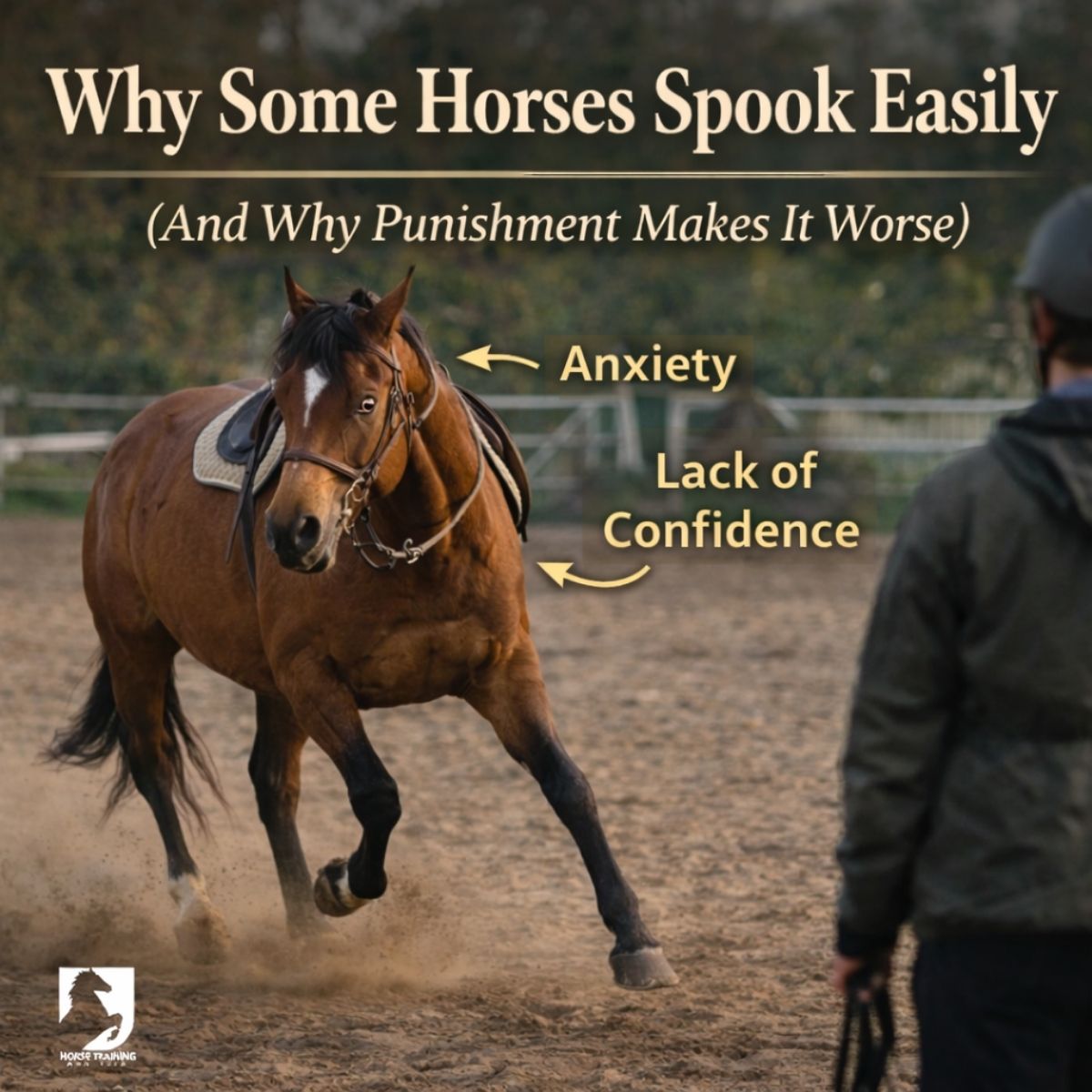
Spooking is one of the most misunderstood behaviours in horses.
It is often treated as naughtiness, lack of respect, or a training failure.
In reality, spooking is usually a sign that a horse does not feel safe enough to think.
Understanding why it happens — and why punishment so often makes it worse — is key to reducing it long term.
What Spooking Actually Is
Spooking is a startle response.
It happens when the horse’s nervous system detects something it cannot immediately categorise as safe.
This response is automatic.
It happens faster than conscious thought.
That matters, because you cannot train a horse out of a reflex using punishment.
Spooking is not a decision
When a horse spooks, they are not choosing to misbehave.
Their body reacts before their thinking brain has time to intervene.
This is why telling a horse off after a spook rarely improves anything.
Why prey animals spook
Horses evolved to survive by noticing change.
Anything unfamiliar, out of place, or sudden triggers investigation.
Most of the time, a confident horse can assess that change quickly.
An anxious or uncertain horse cannot.
Why Some Horses Spook More Than Others
Not all horses respond to uncertainty in the same way.
Spooking frequency varies for several reasons.
Individual sensitivity
Some horses are naturally more sensitive to their environment.
This does not mean they are weak or badly trained.
It means they process more information.
Handled well, these horses often become extremely reliable.
Handled harshly, they become increasingly reactive.
Learning history
Horses that have been frightened, rushed, or punished for uncertainty often spook more over time.
They learn that unfamiliar situations are risky.
Instead of investigating, they brace and react.
Lack of confidence
Spooking is closely linked to confidence.
A horse that trusts their handler or rider is more likely to pause and look.
A horse that lacks confidence reacts first and thinks later.
This relationship is explained in detail here:
Horse Confidence Explained: Helping Anxious and Nervous Horses Feel Safe
Different Types of Spooking
Not all spooks are the same.
Understanding the difference helps you respond appropriately.
The genuine startle
This is a sudden reaction to an unexpected stimulus.
A pheasant flying out of a hedge or a loud bang are classic examples.
These spooks are normal and unavoidable.
The anticipatory spook
Some horses spook before anything has actually happened.
They tense up, scan the environment, and react to imagined threats.
This type of spooking is strongly linked to anxiety.
The learned spook
Horses can learn to spook in certain places or situations.
This often develops when previous fear responses were handled poorly.
The horse remembers feeling unsafe and reacts earlier next time.
Why Punishment Makes Spooking Worse
Many people respond to spooking by telling the horse off.
Some escalate quickly, believing firmness will prevent future reactions.
Unfortunately, this often has the opposite effect.
Punishment confirms the threat
From the horse’s perspective, something worrying happens… and then pressure increases.
Their nervous system links the two.
The environment becomes even less safe.
Punishment increases anticipation
Horses quickly learn to expect correction.
This increases anxiety before anything actually occurs.
Spooking then starts earlier and becomes more frequent.
Punishment removes investigation
Confident horses investigate.
Punished horses avoid.
When investigation is discouraged, fear has nowhere to go except into reaction.
Why “Just Ride Them Through It” Often Backfires
Pushing a horse forward through fear sometimes works — temporarily.
But it often leaves anxiety unresolved.
The horse learns they have no control.
This can lead to bigger reactions later, or complete shutdown.
Early Warning Signs Before Spooking Escalates
Spooking rarely appears without warning.
Early signs are often subtle.
- Raised head and fixed neck
- Shortened stride
- Shallow breathing
- Excessive scanning of the environment
These signs are explored in more detail here:
Signs of Anxiety in Horses (What Owners Often Miss)
Why Consistency Matters More Than Courage
Spooking is rarely solved by bravery.
It is solved by predictability.
Horses gain confidence when they understand what will happen next.
Consistency in handling, expectations, and environment reduces the need to react.
In the next section, we will look at how to respond to spooking in the moment, how to reduce it over time, and how to build confidence without forcing the issue.
Why Some Horses Spook Easily (And Why Punishment Makes It Worse)
How to Respond When a Horse Spooks
What you do in the moment matters, but not in the way many people expect.
The goal is not to suppress the reaction, but to help the horse recover quickly and safely.
Stabilise yourself first
Horses mirror human tension.
If you brace, hold your breath, or tighten suddenly, the horse feels it immediately.
A calm posture, steady breathing, and neutral tone give the horse something to settle against.
Allow a pause without retreat
After a spook, many horses need a brief moment to reassess.
Rushing them forward can increase panic.
Equally, turning away completely can reinforce avoidance.
A small pause, followed by a quiet re-approach, often helps more than force.
Lower the emotional pressure
Reducing rein pressure, softening your seat, or stepping away from the stimulus can help the nervous system settle.
This does not mean letting the horse “get away with it”.
It means creating space for regulation.
What Actually Reduces Spooking Over Time
Spooking reduces when the horse learns that uncertainty is manageable.
This takes repetition, not confrontation.
Gradual exposure
Introducing new environments, objects, or situations in small, manageable steps builds resilience.
The horse learns to stay within their capacity rather than tipping into panic.
Predictable handling
Consistency in cues and expectations helps horses anticipate what comes next.
Predictability reduces the need for defensive reactions.
Confidence before difficulty
Asking for focus in a low-pressure environment before increasing challenge improves outcomes.
Horses that feel successful carry that confidence forward.
Groundwork and Spooking
Groundwork allows spooking to be addressed without the added complexity of a rider.
It provides:
- Clear communication
- Controlled exposure
- Opportunities to pause and investigate
When done thoughtfully, groundwork teaches horses how to process concern rather than flee from it.
For a structured approach, see:
Building Confidence in Nervous Horses on the Ground
Spooking Under Saddle
Ridden spooking often feels more alarming, but the underlying causes are similar.
Balance and security
A horse that feels unbalanced under a rider has less capacity to cope with uncertainty.
Tension in the rider can amplify this effect.
Rider expectation
If you expect a spook, your body often prepares for one.
The horse feels this and becomes more vigilant.
This does not mean you are at fault.
It means awareness is part of progress.
Reducing pressure, not control
Quietly reducing pressure after a spook helps the horse settle.
Strong corrections often create longer-term tension.
A calm ridden approach is explored further here:
Helping Nervous Horses Under Saddle (Without Overfacing Them)
When Spooking Signals Something More
Occasional spooking is normal.
Escalating or persistent spooking is not.
Consider further investigation when:
- Spooking increases despite careful handling
- The horse reacts more strongly over time
- Spooking appears suddenly in a previously settled horse
- There are other signs of discomfort or anxiety
Pain, vision issues, or physical discomfort can all lower a horse’s tolerance.
Behaviour should never be used to rule these out.
From One Horse Person to Another
Spooking is not a sign of failure.
It is a sign that the horse does not yet feel safe enough to process what is happening.
Firmness rarely creates confidence.
Clarity, consistency, and patience do.
If spooking is becoming a pattern, stepping back to look at the bigger picture can help:
Horse Confidence Explained: Helping Anxious and Nervous Horses Feel Safe
Progress comes from helping the horse learn that concern does not automatically lead to pressure.
That lesson takes time — but it lasts.