
Many horses cope well on the ground but struggle once ridden.
This can be confusing and frustrating for owners, especially when groundwork appears solid.
Ridden anxiety does not mean the horse is being difficult.
It usually means the horse is finding the added complexity of balance, expectation, and pressure hard to manage.
This article explains why nervousness often shows up under saddle, how to recognise it early, and how to help horses build confidence without forcing them through fear.
Why Riding Changes Everything for Nervous Horses
Ridden work adds layers.
Balance, weight, coordination, and emotional expectation all come into play at once.
For a nervous horse, this can tip things over their coping threshold.
Physical demands increase
Even light riders change how a horse must use their body.
If balance or strength is lacking, the horse may feel unstable.
Instability reduces emotional capacity.
Pressure becomes continuous
Unlike groundwork, ridden pressure is often present all the time.
Legs, seat, and rein contact create ongoing input.
An anxious horse may struggle to find release.
Expectation rises
Many horses anticipate that ridden work will be harder.
If previous experiences were uncomfortable or confusing, anxiety often appears as soon as the rider mounts.
Early Signs of Ridden Anxiety
Ridden anxiety often starts subtly.
Recognising it early prevents escalation.
Tension on mounting
Fidgeting, walking off, bracing, or hollowing during mounting are common early signs.
These behaviours are often mislabelled as bad manners.
In reality, they frequently reflect anticipation and worry.
Change in way of going
An anxious horse may:
- Rush or slow excessively
- Lose rhythm
- Hollow or brace through the back
- Resist light contact
These changes are communication.
Reduced attention
Scanning, staring, or delayed responses often appear before obvious behaviour.
The horse is using energy to monitor their surroundings instead of the rider.
These signs link closely to overall confidence, explored more fully here:
Horse Confidence Explained: Helping Anxious and Nervous Horses Feel Safe
Why “Just Riding Through It” Often Backfires
Some horses appear to improve when pushed through anxiety.
Others worsen dramatically.
The difference lies in how much capacity the horse has.
Compliance is not confidence
A horse may continue moving forward while becoming more anxious internally.
This anxiety often resurfaces later as spooking, resistance, or shutdown.
Anxiety layers quickly under saddle
Once a horse feels trapped by pressure and balance demands, fear escalates fast.
Each forced experience teaches the horse that ridden work is unsafe.
This pattern is closely linked to spooking behaviour:
Why Some Horses Spook Easily (And Why Punishment Makes It Worse)
Preparing the Horse Before You Ride
Ridden confidence begins before the rider gets on.
Check the emotional state
If the horse is tense, distracted, or unsettled in-hand, riding is unlikely to go well.
Address anxiety on the ground first.
Use groundwork as a bridge
Simple groundwork immediately before mounting can help regulate the nervous system.
This groundwork should feel familiar and achievable:
- Leading calmly
- Standing quietly
- Responding softly to cues
Ground confidence is explored in detail here:
Building Confidence in Nervous Horses on the Ground
First Ridden Steps for Nervous Horses
The first few minutes matter most.
Keep expectations low
The goal is relaxation, not performance.
A quiet walk on a loose rein may be enough.
Allow the horse to settle
Give the horse time to breathe, look, and adjust.
Rushing this stage often creates tension that lasts the entire session.
End early if needed
Short, calm rides build confidence faster than long, pressured ones.
Stopping while the horse is coping is a success.
Common Mistakes With Nervous Horses Under Saddle
Asking for too much too soon
Progress should be incremental.
Adding speed, contact, or complexity too early overwhelms the nervous system.
Ignoring subtle signs
Small changes in breathing, posture, or rhythm often come before bigger reactions.
Responding early prevents escalation.
Correcting anxiety as disobedience
If fear is punished, confidence erodes.
The horse learns that ridden work is unsafe.
In the next section, we will look at how to structure ridden sessions over time, how to build confidence gradually, and how to know when your horse is ready to progress.
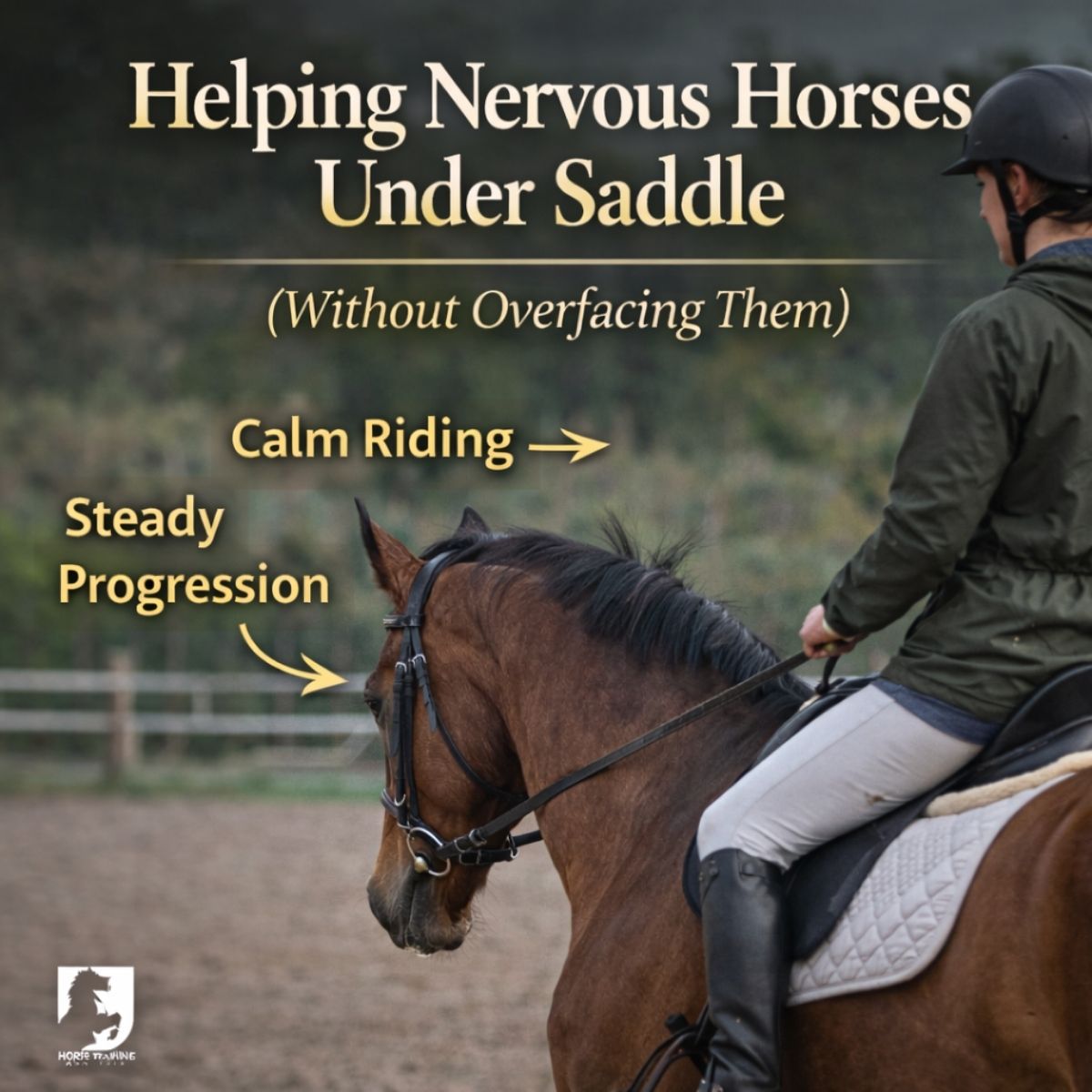
Helping Nervous Horses Under Saddle (Without Overfacing Them)
Structuring Ridden Sessions for Nervous Horses
Nervous horses benefit from ridden sessions that feel predictable and achievable.
This does not mean rigid routines, but a clear structure that reduces uncertainty.
Keep sessions short and focused
Short, calm rides are far more effective than long sessions.
Fifteen to twenty minutes may be plenty for a nervous horse.
Ending while the horse is coping helps the nervous system remember ridden work as manageable.
Repeat calm patterns
Repetition builds security.
If a simple exercise helps the horse relax, repeat it across multiple sessions.
Progress does not need to be constant to be meaningful.
How to Increase Difficulty Without Overfacing
Progress should be incremental and deliberate.
Change one thing at a time
If you introduce a new environment, keep the work simple.
If you add a new exercise, stay in a familiar place.
This prevents overload and helps the horse process change.
Watch recovery, not perfection
Small reactions are not failures.
What matters is how quickly the horse settles afterwards.
Faster recovery is a strong sign that confidence is improving.
Allow confidence to stabilise
When something goes well, repeat it over several rides.
This helps the horse accept the experience as safe.
When Ridden Anxiety Points to Physical Factors
Ridden anxiety is often influenced by physical comfort.
Consider further investigation if:
- Anxiety escalates despite careful progression
- Behaviour changes suddenly
- The horse resists tasks they previously managed easily
- Tension appears consistently in specific movements
Saddle fit, dental comfort, musculoskeletal pain, and vision issues can all affect confidence.
Behaviour should never be used to rule these factors out.
Common Setbacks and How to Handle Them
Inconsistent progress
Good days followed by difficult ones are normal.
Confidence builds unevenly.
Return to what the horse can manage calmly and rebuild from there.
Loss of confidence after time off
Breaks in routine can unsettle nervous horses.
Reintroduce ridden work gently, as if starting again.
Rider tension creeping in
It is natural to feel cautious after setbacks.
Acknowledge this and simplify sessions if needed.
Confidence work is a partnership.
How Ridden Confidence Fits the Bigger Picture
Ridden confidence does not exist in isolation.
It is supported by groundwork, environment, physical comfort, and handling consistency.
If ridden anxiety persists, stepping back to review the wider context can help:
Horse Confidence Explained: Helping Anxious and Nervous Horses Feel Safe
From One Horse Person to Another
Helping a nervous horse under saddle takes patience.
Progress is often quiet and easy to miss.
A deeper breath.
A softer step.
A quicker return to calm.
Those moments matter.
Do not rush to where you think your horse should be.
Work with where they are.
Confidence is not built by pushing through fear.
It is built by helping the horse feel safe enough to try.