
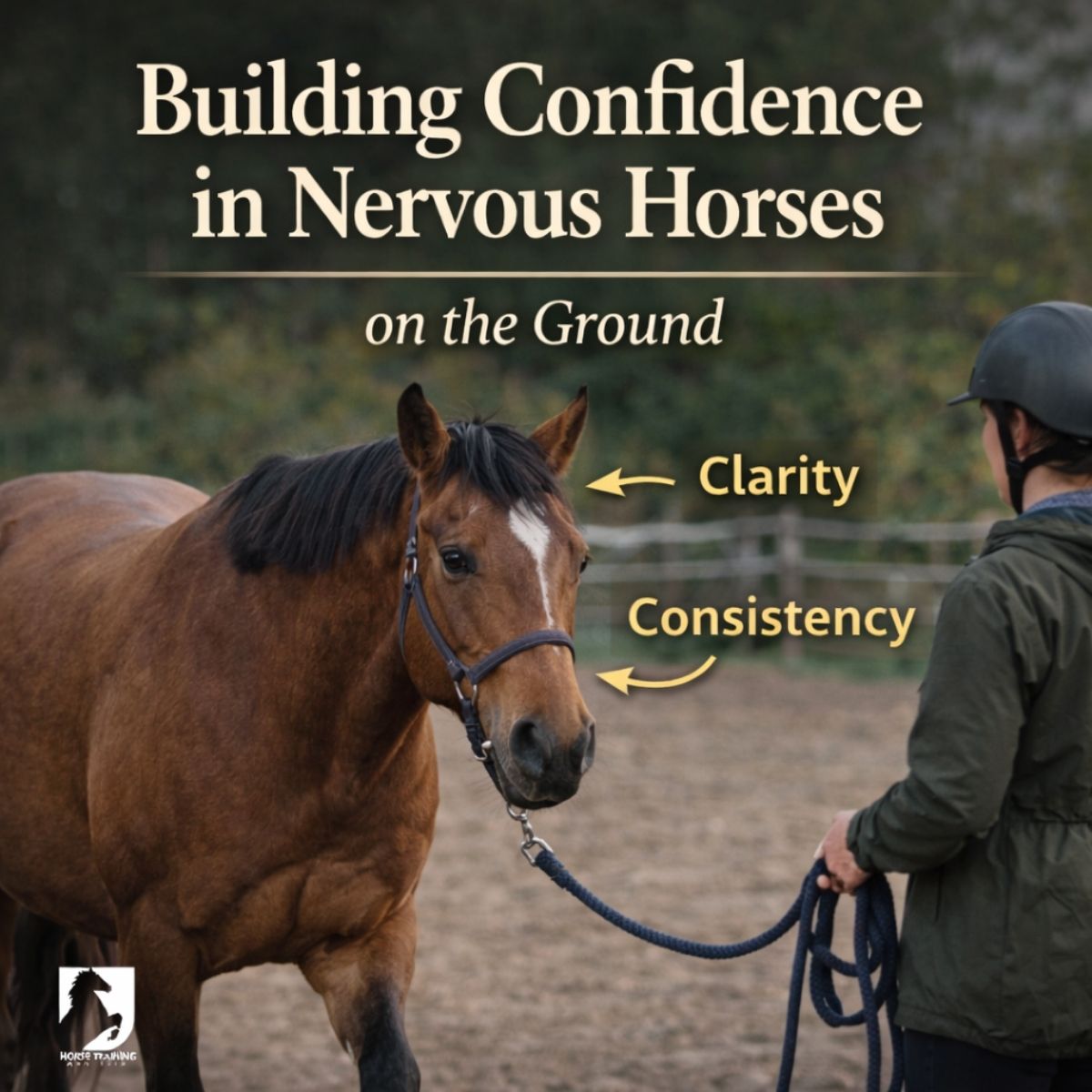
For many anxious or uncertain horses, confidence is best rebuilt on the ground.
Without a rider to balance, respond to, or worry about, the horse has more space to think.
Groundwork is not about dominance or control.
Done well, it is about clarity, predictability, and helping the horse learn that they can cope.
This article explains how groundwork can build real confidence, what to focus on, and where people often go wrong.
Why Groundwork Helps Nervous Horses
Groundwork strips things back.
It removes the physical and emotional complexity of ridden work and allows you to see how the horse is really coping.
For anxious horses, this simplicity matters.
Less pressure on the nervous system
Without a rider, there is less to process.
The horse can focus on one task at a time instead of juggling balance, aids, and environment.
This often lowers anxiety enough for learning to begin.
Clearer communication
On the ground, timing is easier to refine.
Horses receive clearer signals and clearer releases, which builds trust quickly.
Earlier warning signs
Groundwork makes subtle anxiety easier to spot.
Tension, hesitation, or loss of focus often appear sooner and more clearly than under saddle.
These early signs are explored more fully here:
Signs of Anxiety in Horses (What Owners Often Miss)
What Confidence on the Ground Actually Looks Like
Before looking at exercises, it helps to know what you are aiming for.
A confident horse on the ground is not one that never reacts.
It is one that can notice change and still stay mentally available.
Signs of growing confidence include:
- A soft, mobile neck
- Steady breathing
- Ability to pause and wait
- Curiosity without rushing
- Quick recovery after a wobble
These signs matter more than perfect obedience.
Start With Predictability
Nervous horses struggle most with uncertainty.
The first job of groundwork is to make the situation predictable.
Consistent routines
Work in the same space to begin with.
Use the same equipment and keep sessions similar in structure.
This does not make the horse dull.
It gives them a stable base from which confidence can grow.
Clear beginnings and endings
Horses relax when they know when work starts and finishes.
A short, consistent warm-up and a calm end point help regulate the nervous system.
Leading Work and Personal Space
How a horse leads tells you a great deal about their confidence.
Rushing ahead or lagging behind
Anxious horses often struggle to match pace.
Rushing can be an attempt to escape pressure.
Lagging can be hesitation or overload.
The goal is not to force position, but to help the horse stay connected.
Crowding or drifting
Crowding is often a sign of insecurity rather than disrespect.
These horses seek reassurance through proximity.
Calm, consistent boundaries build confidence far more effectively than sharp corrections.
Standing Still Is a Skill
Many nervous horses struggle to stand.
Stillness requires emotional regulation.
Teaching a horse to stand quietly on the ground:
- Improves self-control
- Reduces anticipation
- Builds patience and trust
Start with very short pauses.
Reward calmness, not rigidity.
Using Movement Thoughtfully
Movement can help or hinder confidence, depending on how it is used.
Too much movement
Constant movement can keep anxious horses in a heightened state.
They never fully settle.
Too little movement
For some horses, gentle movement helps release tension.
The key is balance.
Watch breathing and posture.
These tell you whether movement is helping.
Introducing New Stimuli on the Ground
Groundwork is ideal for introducing new objects or environments.
Approach matters more than exposure.
Let the horse investigate
Allow the horse to look, sniff, and process.
Do not rush them past concern.
Control distance, not emotion
Adjust how close you work to the stimulus.
Stay far enough away that the horse can still think.
This principle also applies strongly to spooking behaviour:
Why Some Horses Spook Easily (And Why Punishment Makes It Worse)
Common Groundwork Mistakes With Nervous Horses
Doing too much too soon
Progress feels good.
But rushing foundations often creates setbacks.
Correcting anxiety instead of addressing it
If anxiety is treated as disobedience, confidence erodes.
Ignoring recovery time
Nervous systems need time to settle.
Build pauses into your sessions.
How Groundwork Supports Ridden Confidence
Confidence built on the ground transfers — but not automatically.
Groundwork helps by:
- Improving communication
- Reducing baseline anxiety
- Teaching coping strategies
When ridden work resumes, these skills provide a foundation.
In the next section, we will look at specific groundwork approaches, how to structure sessions over time, and how to know when your horse is ready to progress.
Building Confidence in Nervous Horses on the Ground
Structuring Groundwork Sessions for Nervous Horses
Nervous horses benefit from structure.
Not rigidity, but a predictable flow that helps the nervous system settle.
Groundwork sessions do not need to be long.
In fact, shorter sessions are often more effective.
Keep sessions brief and purposeful
Ten to twenty minutes is often enough.
Beyond that, anxious horses may lose focus or become overwhelmed.
End while the horse is still coping.
Finishing on a calm note builds confidence faster than pushing for one more improvement.
Repeat what helps the horse settle
Progress comes from repetition of calm experiences.
If something helps the horse relax, include it regularly.
Variety can come later.
Early confidence thrives on familiarity.
How to Progress Without Overfacing
One of the biggest risks in confidence work is progressing too quickly.
Change one thing at a time
If you change the environment, keep the task simple.
If you increase difficulty, keep the surroundings familiar.
This prevents the horse from becoming overloaded.
Watch recovery, not just reaction
Small reactions are not a problem.
How quickly the horse settles afterwards matters more.
If recovery is getting faster, confidence is improving.
Allow confidence to stabilise
When something goes well, repeat it across several sessions.
This helps the nervous system accept it as safe.
When Groundwork Is Not Enough on Its Own
Groundwork is powerful, but it is not a cure-all.
Sometimes anxiety persists despite careful handling.
Signs groundwork alone may not be sufficient
- Anxiety escalates rather than settles
- The horse becomes increasingly tense over time
- Reactions appear suddenly and intensely
- There are signs of physical discomfort
In these cases, pain, vision issues, or previous negative experiences may be contributing.
Behaviour should never be used to rule physical causes out.
Transferring Ground Confidence to Ridden Work
Ground confidence supports ridden confidence, but it does not automatically transfer.
When reintroducing ridden work:
- Start in the calmest environment possible
- Keep sessions short and simple
- Focus on relaxation rather than performance
If anxiety appears once mounted, it is often a sign that the horse needs more time.
A gradual ridden approach is explored in more detail here:
Helping Nervous Horses Under Saddle (Without Overfacing Them)
Common Setbacks and How to Handle Them
Good days followed by bad days
This is normal.
Confidence does not build in a straight line.
Return to what the horse can manage and rebuild from there.
Plateaus
If progress stalls, resist the urge to push.
Often the horse is processing rather than regressing.
Regression after change
Yard moves, routine changes, or time off can temporarily unsettle confidence.
Re-establish familiar groundwork before adding challenge.
From One Horse Person to Another
Groundwork is not about making a horse obedient.
It is about helping them feel safe enough to learn.
Progress often looks quiet.
A softer neck, a deeper breath, a quicker recovery.
Those small signs matter.
If you ever feel stuck, returning to the bigger picture can help:
Horse Confidence Explained: Helping Anxious and Nervous Horses Feel Safe
Confidence is built one calm, consistent moment at a time.
And groundwork is often where that journey begins.