
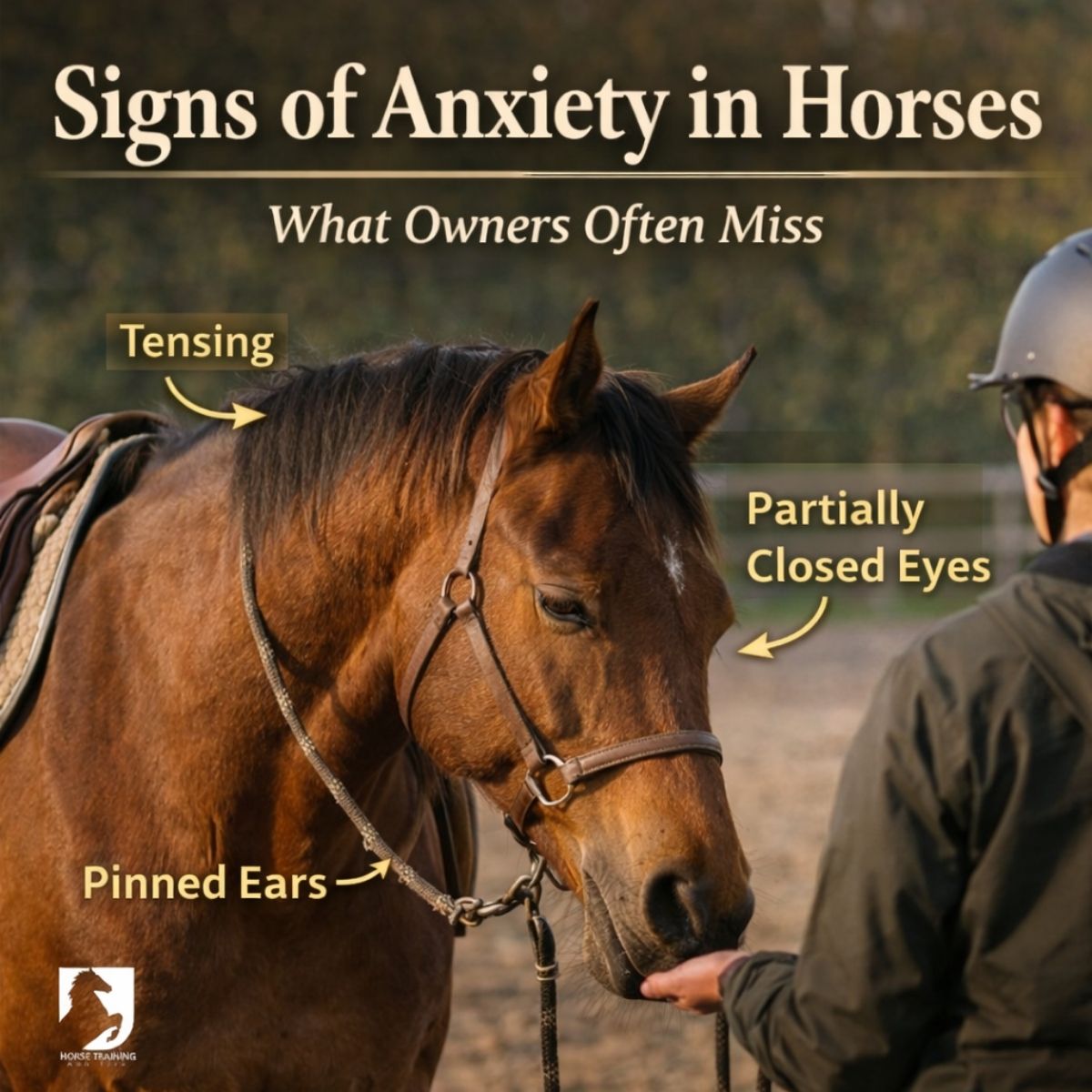
Horse anxiety is often misunderstood because it does not always look dramatic.
Many anxious horses never rear, bolt, or explode. Instead, they cope quietly — until they can’t.
This article is about the early and easily missed signs of anxiety in horses.
Not the obvious blow-ups, but the subtle behaviours that tell you a horse is struggling long before things escalate.
If anxiety is caught early, confidence can be rebuilt thoughtfully.
If it is missed or dismissed, it often shows up later as a much bigger problem.
Why Anxiety in Horses Is So Often Missed
Horses are exceptionally good at coping.
As prey animals, they are wired to manage stress quietly and conserve energy until they need to react.
This means anxiety often hides behind behaviours that look:
- Manageable
- Normal
- “Just how the horse is”
Many anxious horses are labelled lazy, rude, sharp, stubborn, or inattentive.
In reality, they are working hard to stay within their limits.
Understanding these early signs matters, because anxiety is not a personality flaw.
It is information.
Anxiety, Stress, and Excitement Are Not the Same
Before looking at specific signs, it helps to separate anxiety from other arousal states.
Stress
Stress is the body responding to demand.
Short-term stress is normal and unavoidable.
Problems arise when stress stays elevated for too long.
Excitement
Excitement is high energy with a positive expectation.
An excited horse may feel sharp, forward, or reactive, but they recover quickly.
Anxiety
Anxiety is anticipation of discomfort, threat, or confusion.
The horse expects something to be difficult, unpleasant, or overwhelming.
An anxious horse does not relax easily, even when nothing obvious is happening.
This distinction is important, because managing excitement requires different handling from addressing anxiety.
Subtle Physical Signs of Anxiety
Many anxious horses show physical signs long before behaviour changes.
These signs are easy to overlook if you are focused only on obedience.
Tension through the body
An anxious horse often carries tension even when standing still.
Common areas include the neck, jaw, back, and hindquarters.
You may notice:
- A rigid neck rather than a soft one
- A tight jaw or clamped mouth
- Minimal swing through the back
- Short, guarded steps
This tension is often mistaken for stiffness or laziness.
In reality, the horse is bracing.
Breathing patterns
Breathing is one of the clearest indicators of anxiety.
An anxious horse may breathe shallowly, hold their breath, or sigh repeatedly.
Rapid breathing during light work, especially when paired with tension, often signals emotional stress rather than fitness issues.
Changes in posture
Anxiety can subtly change how a horse carries themselves.
Look for:
- Head held higher than normal
- Neck fixed rather than mobile
- Weight shifted back or away from a stimulus
These changes are protective responses.
Behavioural Signs That Are Often Misread
Many anxious behaviours are labelled as training issues.
This is where anxiety is most commonly missed.
Restlessness and inability to stand still
Fidgeting is a classic anxiety sign.
Horses may paw, shift weight, swing their quarters, or mouth the bit or rope.
These horses are often corrected for being rude.
In reality, movement is how they release nervous energy.
Hesitation and delay
An anxious horse often hesitates before responding.
This pause is frequently interpreted as stubbornness.
In fact, the horse is assessing risk.
If hesitation is punished, anxiety usually increases.
Overreaction to small changes
Anxious horses often react strongly to minor environmental changes.
A moved cone, a new filler, or a change in routine can trigger tension.
This is not naughtiness.
It reflects a low tolerance for unpredictability.
This pattern is explored more fully here:
Why Some Horses Spook Easily (And Why Punishment Makes It Worse)
Switching off or dull responses
Not all anxious horses look sharp.
Some become quiet, slow, or disengaged.
These horses may:
- Ignore light aids
- Move without expression
- Show little curiosity or initiative
This is often mistaken for laziness.
In reality, it can be a coping strategy.
Situational Anxiety: When Behaviour Changes by Context
One of the clearest signs of anxiety is inconsistency.
A horse may cope well in one situation and struggle in another.
Common examples include:
- Calm hacking but anxious schooling
- Settled groundwork but tension once ridden
- Relaxed at home but reactive at new venues
This does not mean training has failed.
It means confidence has not yet been built in that context.
This is a key theme in the pillar article:
Horse Confidence Explained: Helping Anxious and Nervous Horses Feel Safe
Why Early Anxiety Matters
Anxiety rarely disappears on its own.
If ignored, it often escalates into more obvious behaviour.
Horses that cope quietly are often the ones who surprise people later.
The signs were there — just subtle.
Recognising anxiety early allows you to adjust handling, expectations, and training before confidence is seriously undermined.
In the next section, we will look at anxiety during handling, groundwork, and ridden work — and how to tell when concern is tipping into something more serious.
Signs of Anxiety in Horses: What Owners Often Miss
Anxiety During Everyday Handling
Some of the clearest anxiety signals appear during routine handling.
Because these moments happen daily, the signs are often normalised or overlooked.
Leading issues
An anxious horse may rush ahead, lag behind, crowd your space, or plant suddenly when led.
These behaviours are often labelled as poor manners.
In reality, they frequently reflect uncertainty about pressure, environment, or expectations.
Horses that feel confident in-hand usually match your pace and stay mentally present.
Grooming and tacking sensitivity
Anxiety often shows up as restlessness during grooming or tacking.
Look for tail swishing, skin twitching, pinned ears, or an inability to stand quietly.
These responses are sometimes dismissed as attitude.
They are often early warnings that the horse feels uncomfortable or unsure.
Mounting behaviour
Horses that fidget, walk off, or brace at the mounting block are frequently anxious rather than disobedient.
Mounting combines anticipation, balance, and past experience.
If anxiety is present here, it is important not to ignore it.
Anxiety During Groundwork
Groundwork often reveals anxiety clearly because the horse is not also managing a rider.
Difficulty staying connected
An anxious horse may struggle to stay mentally engaged.
You might notice wandering attention, sudden startle responses, or frequent checking of the environment.
This does not mean the horse is unfocused by choice.
It means their nervous system is overloaded.
Escalation with repetition
When anxiety is present, repeating an exercise often makes things worse rather than better.
The horse becomes tighter, quicker, or more resistant instead of more settled.
This is a clear signal that the task is exceeding the horse’s current ability to cope.
How to address this thoughtfully is covered here:
Building Confidence in Nervous Horses on the Ground
Anxiety Under Saddle
Ridden anxiety is one of the most commonly misunderstood issues in horses.
Tension that appears once mounted
Some horses seem calm on the ground but change as soon as the rider gets on.
They may hollow, rush, resist the contact, or become inattentive.
This shift often points to a combination of physical comfort, balance, and emotional pressure.
Overreaction to normal aids
An anxious horse may react strongly to light leg or rein aids.
This is sometimes described as being sharp or over-sensitive.
In many cases, the horse is already tense and close to their limit.
Loss of rhythm and relaxation
Anxiety frequently shows up as irregular rhythm.
Transitions become abrupt, and the horse struggles to maintain a steady tempo.
These horses are often told to “settle”, but their nervous system does not yet know how.
A sympathetic approach to ridden confidence is explored in more detail here:
Helping Nervous Horses Under Saddle (Without Overfacing Them)
When Anxiety Signals Pain or Physical Discomfort
Anxiety and pain are closely linked.
Horses that anticipate discomfort often become anxious before work even begins.
Red flags that warrant further investigation include:
- Sudden changes in behaviour
- Escalating anxiety despite careful handling
- Reluctance to perform previously easy tasks
- Defensive reactions during grooming or tacking
Behaviour should never be used to rule pain out.
If anxiety does not improve with sensible training adjustments, physical comfort must be reassessed.
When Anxiety Becomes a Behaviour Problem
If early anxiety is missed, behaviour often escalates.
Common developments include:
- Spooking that increases rather than settles
- Napping or planting
- Bucking, rearing, or bolting
- Complete shutdown or refusal
At this stage, the behaviour itself becomes the focus.
Unfortunately, this often leads to firmer handling, which further undermines confidence.
Understanding anxiety early can prevent this cycle.
When to Slow Down and When to Seek Help
Not every anxious horse needs professional intervention.
Many benefit simply from adjusted expectations and clearer communication.
It is sensible to seek help when:
- Anxiety escalates despite careful, consistent handling
- The horse becomes unsafe to manage or ride
- You feel tense, frustrated, or unsure how to proceed
- Physical discomfort is suspected
A good professional should prioritise clarity, safety, and the horse’s emotional state.
From One Horse Person to Another
Anxious horses are not trying to be difficult.
They are communicating that something feels too hard, too fast, or too uncertain.
Listening early is one of the kindest and most effective things you can do.
Small adjustments made early can prevent months or years of frustration later.
If you are unsure where to begin, returning to the broader picture can help:
Horse Confidence Explained: Helping Anxious and Nervous Horses Feel Safe
Progress does not come from pushing harder.
It comes from helping the horse feel safe enough to try.